
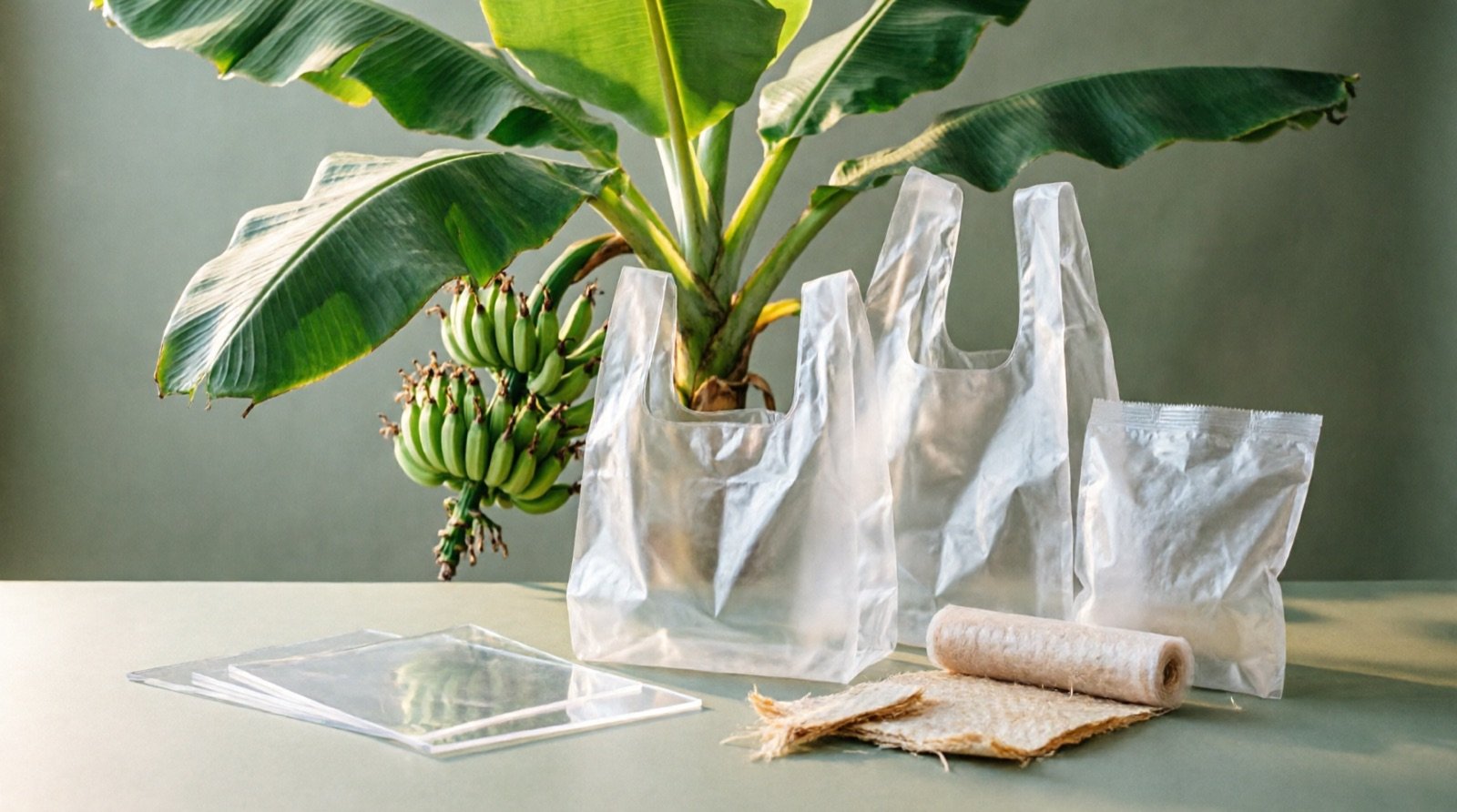
Sustainability is not a marketing claim. It is our operating system.
At BANANCO, sustainability is not a marketing claim — it is our operating system. Every ton of biomass we process, every farmer we partner with, and every job we create is tracked, measured, and reported against rigorous international standards. From the fields of Kenitra to the boardrooms of global industry, we are proving that economic growth and ecological regeneration can coexist.
Biomass/yr
Avoided/yr
Partnered
Created
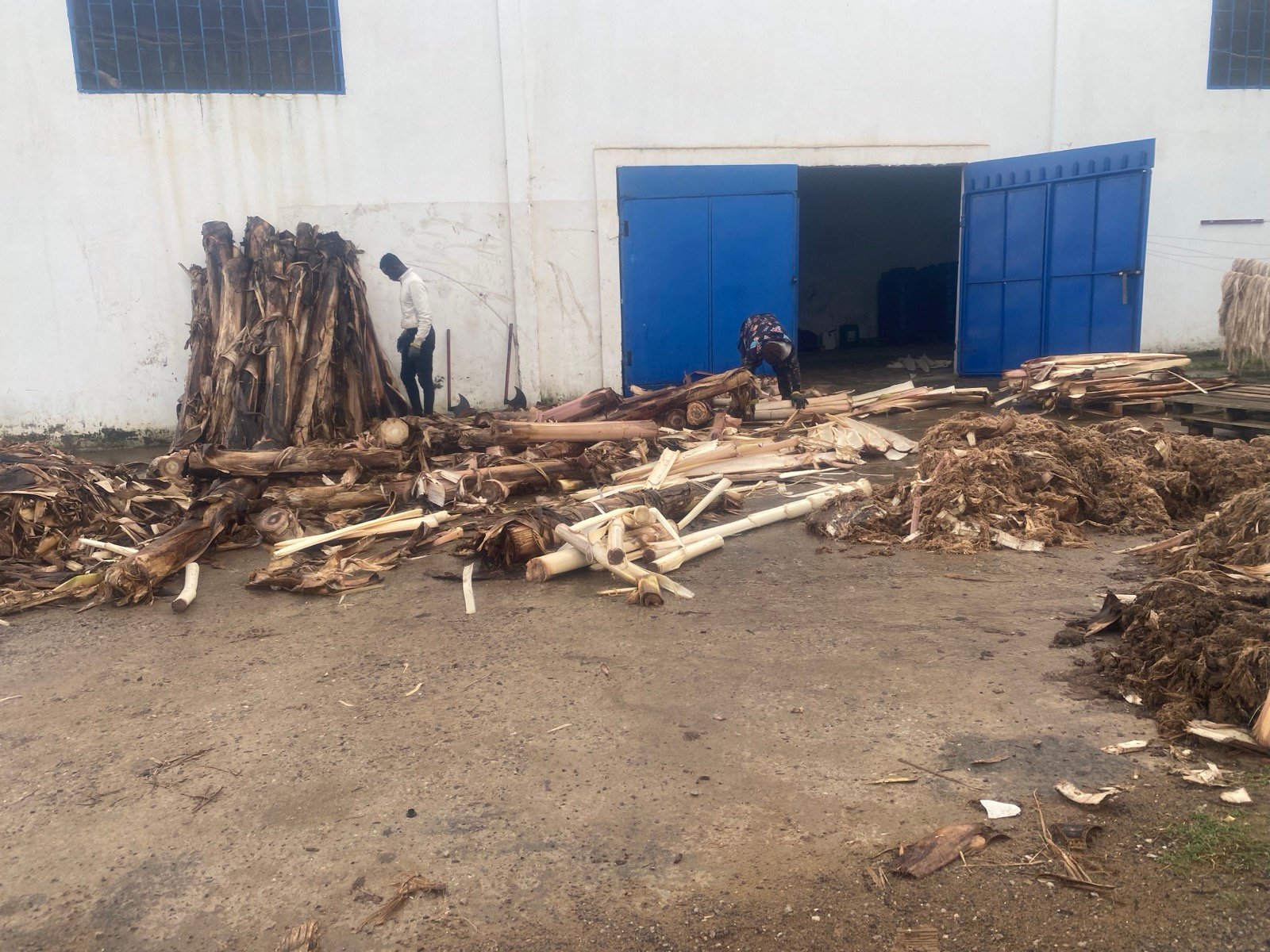
Biomass intercepted before it is burned or left to rot
Intercepting the waste stream.
Agricultural waste is one of the most underutilized resources on Earth. In Morocco alone, thousands of tons of banana pseudostems are burned or left to decompose annually — releasing greenhouse gases, degrading soil, and polluting waterways. BANANCO's zero-waste biorefinery model intercepts this waste stream and transforms it into a force for ecological regeneration.
Emissions avoided
5,000 tons of CO₂ equivalent prevented annually by eliminating open burning of banana biomass. An additional 200 tons of methane (CH₄) avoided by preventing anaerobic decomposition. → Equivalent to removing 1,100 cars from the road every year.
Water conservation
15,000 m³ of water saved annually through our closed-loop extraction and recycling system. Every liter of process water is treated, filtered, and reused — protecting the vital water tables of the Gharb-Chrarda region.
Soil regeneration
2,000 tons of organic compost returned to partner farms annually. Our composting of residual biomass restores soil microbiome health, increases organic carbon content, and reduces dependency on synthetic fertilizers by up to 40%.
Deforestation prevention
1,500 tons of virgin wood pulp displaced annually by our tree-free banana paper pulp. Every ton of our pulp saves approximately 17 trees and 2.5 hectares of forest from exploitation.
Fossil fuel displacement
500,000 liters of gasoline equivalent displaced annually through our bioethanol production. Our second-generation cellulosic bioethanol reduces carbon intensity by 70-85% compared to fossil fuels.
Synthetic material replacement
2,000 tons of petroleum-based synthetic fibers displaced annually by our banana industrial fibers — fibers that are 100% biodegradable, renewable, and locally sourced.
We don't just reduce harm — we regenerate. Every process we design is guided by a single question: does this leave the land better than we found it?
Empowering Communities, Preserving Heritage
Sustainability without social justice is incomplete. BANANCO's model places farmers, women, and youth at the center of the bio-economy transition. By monetizing agricultural “waste,” we transform poverty into prosperity, rural exodus into rural revitalization, and ancestral knowledge into globally competitive innovation.
Social metrics
Farmer partnerships
500+ smallholder farmers integrated into our partnership network by Year 3 (up from 25 today). Each farmer earns 5,000 to 15,000 MAD in supplementary annual income from biomass sales — income that was previously zero.
Decent green jobs
39 full- and part-time formal green jobs created within 12 months (as committed under the GIZ “Invest for Jobs” / BMZ “Decent Work for a Just Transition” initiative). Scaling to 80+ direct jobs and 300+ indirect supply chain jobs by Year 3.
Gender equality
40% target for women farmers in our partnership network. Women gain independent income streams, financial autonomy, and elevated decision-making power within their households and communities.
Youth retention
50% of new hires will be youth (under 30 years old). By demonstrating that agriculture can be modern, profitable, and dignified, we combat the devastating trend of rural exodus and keep Morocco's agricultural heritage alive.
Capacity building
1,000+ community members trained in biomass valorization and circular economy principles. Partnerships with 5 local schools integrate sustainable agriculture into educational curricula.
Cultural preservation
20+ traditional banana farming and waste management practices documented and integrated into our modern biorefinery processes. 10 annual workshops connect traditional farmers with modern biotechnology experts.
For me, being an entrepreneur means finding solutions where others see problems. It's about facing the challenge with determination and creativity.
Building a Circular Bio-Economy
BANANCO's integrated biorefinery model proves that sustainability and profitability are not opposing forces — they are mutually reinforcing. By transforming zero-value agricultural waste into a spectrum of high-value industrial materials, we create multiple revenue streams while eliminating waste, reducing costs, and building resilience against climate and market shocks.
Economic metrics
Circular economy model
100% of biomass valorized through a cascading extraction process:
- Stage 1: Industrial fibers (textiles, automotive, construction)
- Stage 2: Nanocellulose (biomedical, advanced composites)
- Stage 3: Bioethanol (renewable fuel)
- Stage 4: Organic compost (returned to farms)
→ Zero waste. Zero landfill. Zero burning.
Farmer income multiplier
Farmers save 30% on waste disposal costs while earning 5,000-15,000 MAD annually from biomass sales. This transforms a cost center into a profit center for rural households.
Industrial competitiveness
- >2% fiber extraction rate (wet weight) — economically excellent and globally competitive
- Cold plasma technology reduces chemical usage by 60%
- Proprietary treatment achieves sisal-grade fiber properties
- Nanocellulose purity >95% at $50-100/kg market value
Export potential
30% of production targeted for Southern European and international B2B markets by Year 3, positioning Morocco as a nearshoring hub for sustainable industrial materials.
Scalability
Biorefinery model replicable to other agricultural waste streams: pineapple leaves, sugarcane bagasse, date palm residues. Pilot projects planned by Year 3.
Aligned with the United Nations Sustainable Development Goals
Every aspect of BANANCO's operations is designed to advance the UN's 2030 Agenda for Sustainable Development. Our impact maps directly to seven core SDGs, with measurable contributions tracked and reported annually.
No Poverty
Providing supplementary income to 500+ smallholder farmers, transforming agricultural waste into a poverty-alleviation tool. Supported by INDH's rural development mandate.
Decent Work and Economic Growth
Creating 39+ formal green jobs under GIZ/BMZ “Decent Work for a Just Transition” standards. Scaling to 80+ direct and 300+ indirect jobs with fair wages and safe conditions.
Industry, Innovation and Infrastructure
Building Africa's first integrated banana biorefinery with cold plasma, nanocellulose, and bioethanol technologies. Incubated by Cluster VALBIOM MAROC.
Responsible Consumption and Production
Zero-waste cascading biorefinery model. 100% biomass valorization. Tree-free paper pulp. Biodegradable materials.
Climate Action
Avoiding 5,000 tons CO₂ and 200 tons CH₄ annually. Displacing 500,000 liters of fossil fuels with bioethanol.
Life on Land
Returning 2,000 tons of organic compost to farms. Preventing deforestation by displacing 1,500 tons of wood pulp.
Partnerships for the Goals
Multi-stakeholder ecosystem: UN ILO, GIZ, INDH, Cluster VALBIOM, and 14 strategic investors (M Founders consortium).
| Index | Present value | Goal (Year 3) |
|---|---|---|
| Treated biomass | 500 tons/year | 10,000 tons/year |
| Avoided CO₂ emissions | 200 tons/year | 5,000 tons/year |
| Partner farmers | 25 | 500+ |
| Direct green jobs | 12 | 80+ |
| Indirect jobs | 78 | 300+ |
| Produced fibers | 200 tons/year | 2,000 tons/year |
| Nanocellulose | — | 5 tons/year |
| Bioethanol | — | 100,000 liters/year |
| Pulp | — | 500 tons/year |
| Water conservation | — | 15,000 m³/year |
| Recycled organic fertilizer | — | 2,000 tons/year |
Join the Regenerative Revolution
Whether you're an industrial buyer seeking sustainable materials, an investor looking to back Africa's bio-economy, a farmer eager to monetize your agricultural waste, or a policymaker shaping the future of circular agriculture — BANANCO invites you to be part of a movement that is healing the planet while building prosperity.
The future is not just sustainable. It is regenerative. And it starts here, in the fields of Kenitra.